

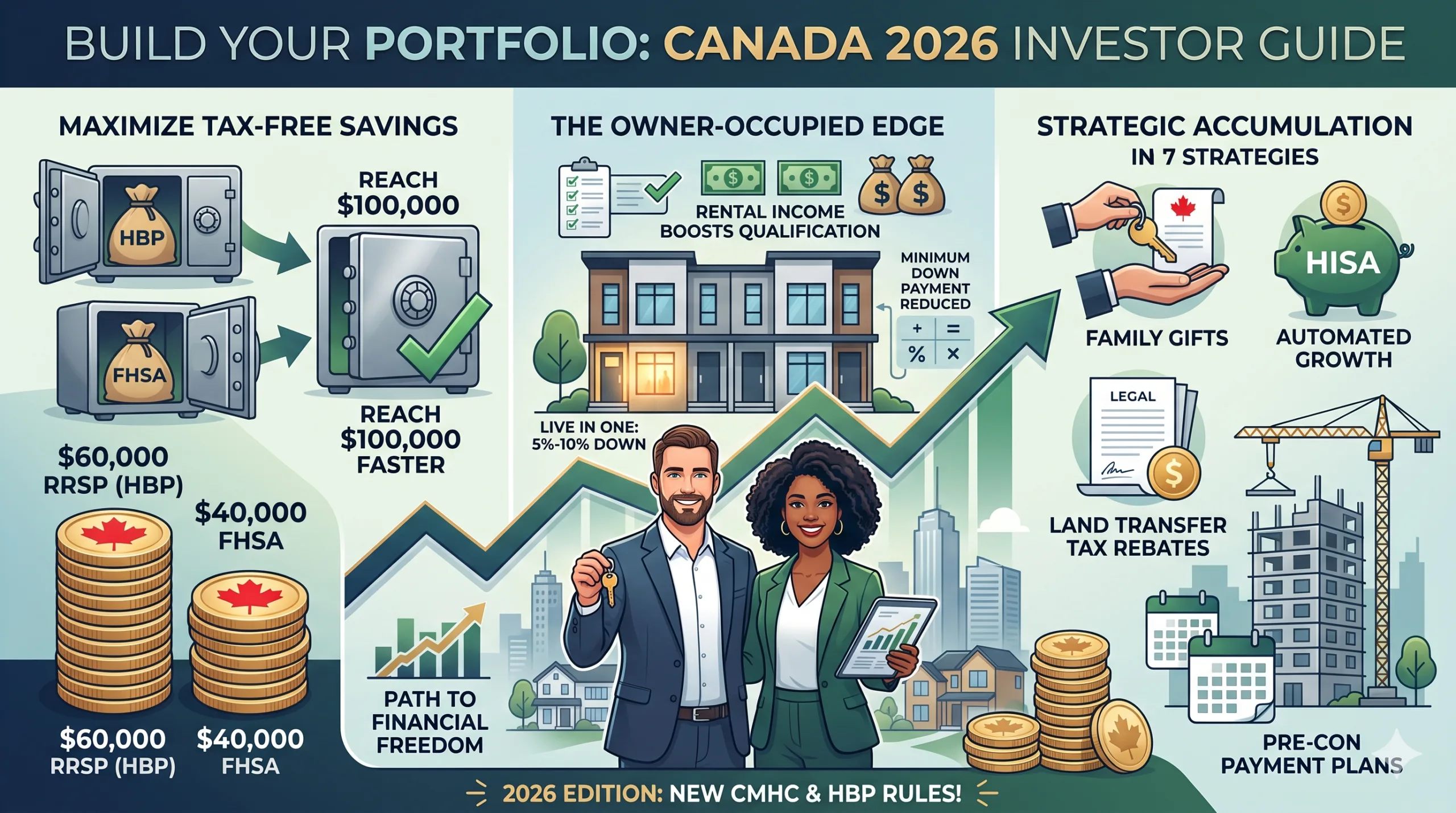
Looking for smart investment property down payment strategies in Canada can feel like climbing a financial mountain. I often see prospective investors hit a wall when they assume lenders have impossibly strict requirements. While it's true that buying a strict rental property requires you to put down 20% to 25% of the purchase price, the barrier to entry is lower than you might think. Under current CMHC guidelines, at least one borrower only needs a minimum credit score of 600 to qualify.
A million-dollar strict investment property means you need $200,000 upfront. For many Canadians, this amount seems out of reach.
But it doesn't have to be. Over my time advising clients, I've found several strategic, completely legal ways to reach your investment goals faster. By leveraging the right tax-sheltered accounts, understanding new CMHC rules, and structuring your purchases correctly, that mountain becomes a walkable path.
Here are 7 proven strategies I use to help clients tackle the down payment challenge for investment properties in Canada.
The Game-Changer: “Strict Investing” vs. “House-Hacking”
Before we dive into the strategies, we need to draw a hard line between two types of investing.
If you are buying a "strict rental" (a property you will never live in), the government mandates a 20% minimum down payment. However, if you are willing to become an "owner-occupier" (living in one unit while renting out the others—often called "house-hacking"), the government opens up massive tax shelters and lower down payment tiers that strict investors simply cannot access.
Strategies 1, 2, and 3 below are specifically designed for owner-occupied investments. If you are willing to live in the property for at least the first year, these are your fastest routes to entering the market.
Step 2: Update the Opening of Strategy 1
To hammer the point home, make a slight adjustment to the opening paragraph of your first strategy so there is absolutely no confusion about the FHSA and RRSP rules.
1. Maximize the RRSP and FHSA Together (Owner-Occupied Only)
If you are utilizing the house-hacking method and intend to occupy the property within a year of buying it, I've discovered a powerful way to build your down payment by combining the RRSP Home Buyers' Plan (HBP) and the First Home Savings Account (FHSA). These two programs work together to create massive tax advantages, helping you save your down payment much faster.
The “Double-Dip” Tax Advantage
This dual approach offers amazing tax benefits. FHSA contributions are tax-deductible just like RRSPs, but they also let you withdraw money completely tax-free (like a TFSA) when used for a qualifying home purchase.
Your taxable income drops significantly when you contribute to both accounts. By putting in the FHSA maximum of $8,000 annually (up to a $40,000 lifetime limit) along with your RRSP contributions, you can save thousands in taxes each year. The strategy creates a "double-dip" effect: put money in your RRSP, claim the tax refund, and use that refund to fund your FHSA.
HBP and FHSA Coordination
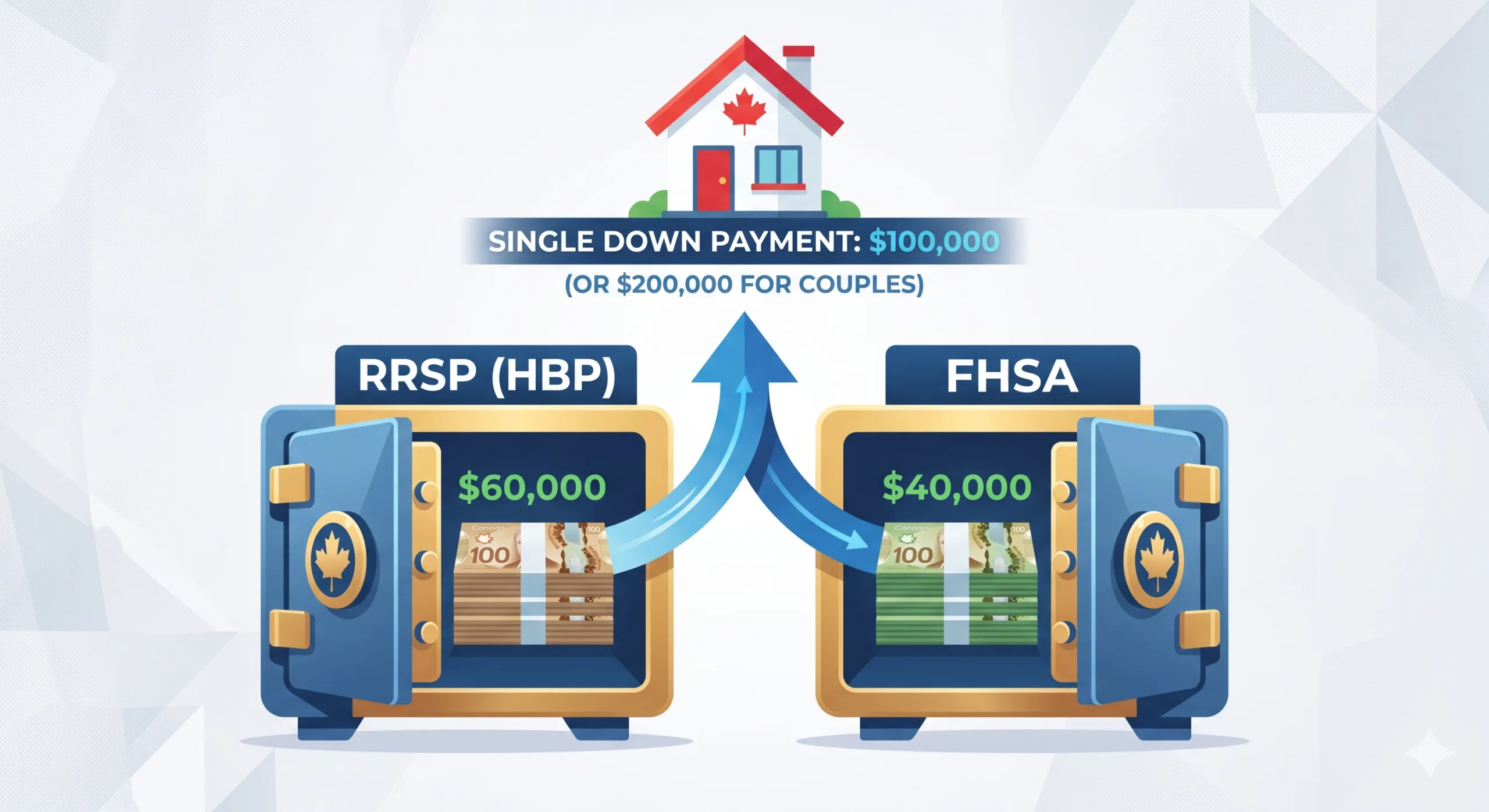
Combining the RRSP Home Buyers' Plan (HBP) and the First Home Savings Account (FHSA) allows an individual to unlock up to $100,000 (or $200,000 for couples) in tax-sheltered capital for their purchase.
The HBP withdrawal limit was recently increased to $60,000 per person. You'll need to pay this back to your RRSP within a 15-year window. FHSA withdrawals, however, do not need to be repaid.
Let's look at a couple buying a home together. Each person can take $60,000 from their RRSPs through the HBP (totaling $120,000), plus up to $40,000 each from their FHSAs. This gives a couple access to $200,000 in tax-advantaged, penalty-free funds for their purchase.
Note: To use these accounts, you must meet the definition of a first-time homebuyer and intend to occupy the property as your principal residence within a year of buying it.
2. The “Live In One, Rent The Rest” Strategy (Owner-Occupied)
If you are willing to become an owner-occupier, the down payment rules change entirely. You no longer need a 20% down payment to buy a multi-unit investment property.
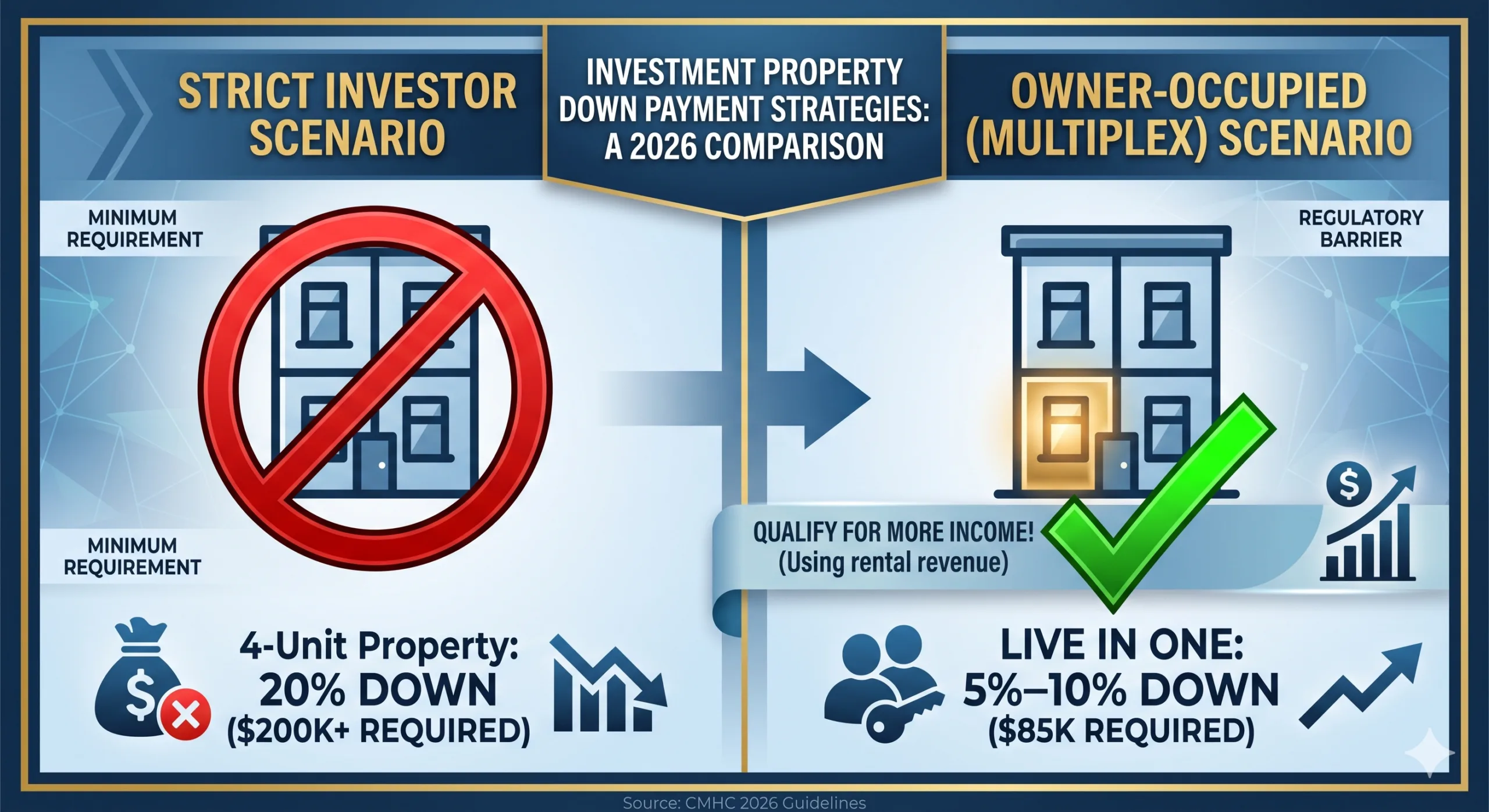
Under 2026 CMHC guidelines, owner-occupying one unit of a multiplex dramatically lowers your down payment barrier from 20% to as low as 5% to 10%, while allowing you to use rental revenue to boost your qualifying income.
The 2026 CMHC Multiplex Advantage
The Canada Mortgage and Housing Corporation (CMHC) allows you to purchase a multi-unit property with a significantly lower down payment than a strict investment property, provided you live in one of the units and the purchase price is under the $1.5 million cap.
The minimum requirement depends on the number of units you are buying:
- For 1 to 2 Units (Single-Family or Duplex): 5% on the first $500,000 and 10% on the remaining amount.
- For 3 to 4 Units (Triplex or Fourplex): A flat 10% of the total purchase price.
The Numbers in Action
Let’s look at a $1.1 million duplex. As a strict non-occupying investor, you would need $220,000 (20%) upfront. By living in one unit, your requirement drops drastically:
- 5% of $500,000 = $25,000
- 10% of the remaining $600,000 = $60,000
- Total Down Payment = $85,000 (Just 7.7% of the purchase price).
However, for a $1.1 million fourplex. As a strict non-occupying investor, you would need $220,000 (20%) upfront. By living in one unit, CMHC rules dictate a flat 10% down payment requirement. Total Down Payment = $110,000
CMHC Multiplex Down Payment Calculator
Drag the slider to adjust the purchase price and see the minimum down payment change in real time.
*Assumes you will live in one of the units.
Required Down Payment
The Qualification Boost
The biggest hurdle to buying a multi-unit property isn't always the down payment; it's proving you have enough income to pass the stress test. When you live in one unit, lenders allow you to add 50% of the projected gross rental income from the other units directly to your qualifying income.
Ready to see what you qualify for? The math changes based on your target neighborhood's cap rates and your current debt ratios. Book a mortgage-readiness consultation with me today, and we will build a holistic financial plan that maps out your exact timeline to your first multi-unit property.
3. Apply for Provincial Land Transfer Tax Rebates
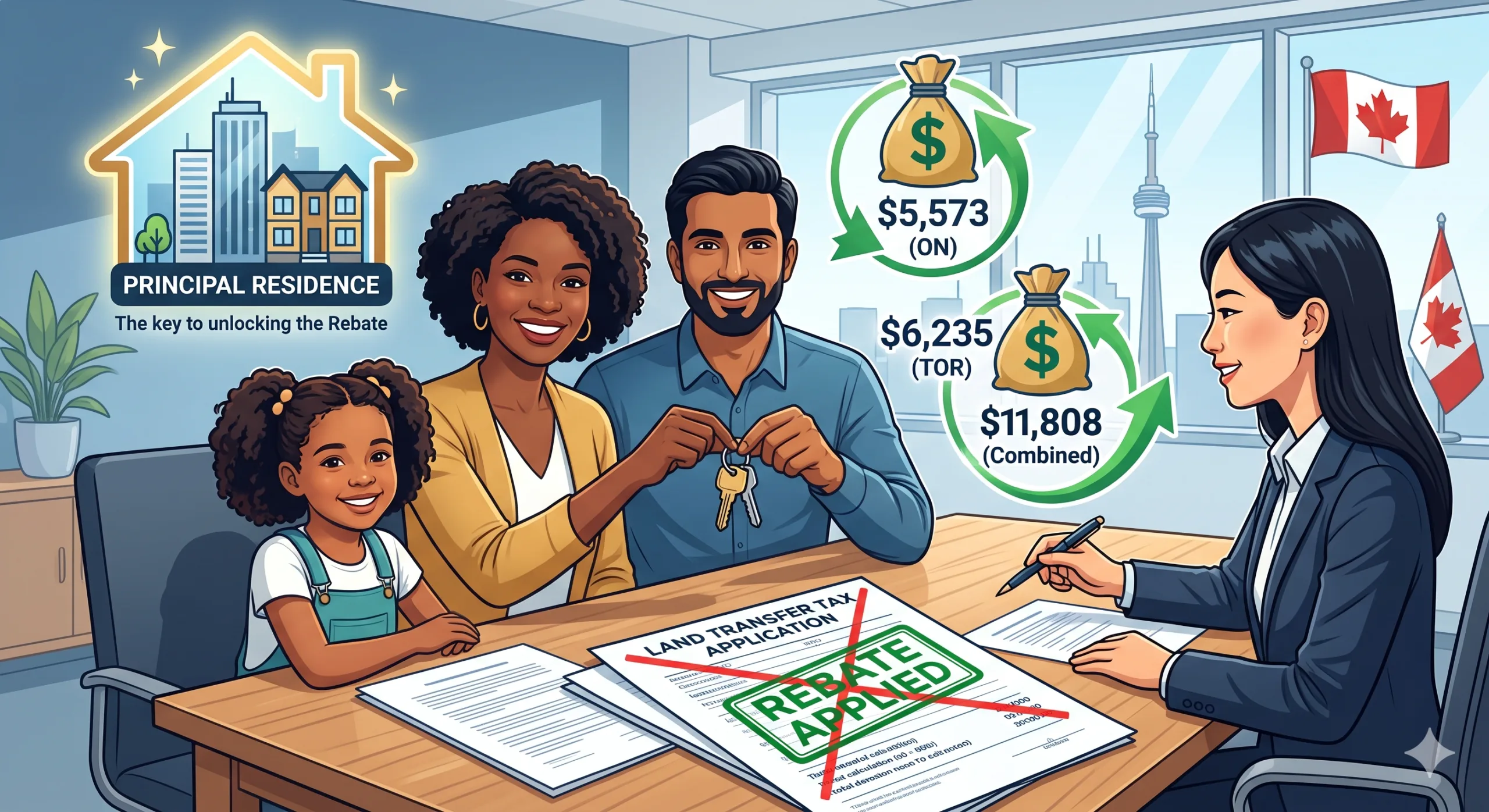
Structuring your first purchase as owner-occupied can unlock stacked provincial and municipal land transfer tax rebates, saving you up to $11,808 on closing costs in municipalities like Toronto.
Land transfer tax (LTT) rebates are a hidden gem that many overlook when building capital. Lower closing costs lead directly to higher down payment possibilities.
LTT is a provincial tax that buyers pay when property ownership changes hands. However, if you are purchasing a property you intend to live in (tying into the strategy above), you may qualify for first-time buyer rebates.
For example:
- British Columbia: First-time buyers can be completely exempt from the property transfer tax on qualifying homes, representing huge savings since BC charges 1% on the first $200,000 and 2% on the portion up to $2,000,000.
- Ontario: First-time homebuyers can receive a rebate of up to $4,000 provincially. If you buy in Toronto, you can receive an additional municipal rebate of up to $4,475, totaling $8,475 in savings.
Smart investors tap into these rebates by structuring their first purchase as owner-occupied. This strategy saves thousands in upfront costs, leaving more cash in your pocket.
4. Utilize Gifted Down Payments from Family
Family money has become a vital part of Canadian property investment. A recent CIBC study showed that nearly a third of first-time buyers receive financial help from their families.
CRA Rules on Gifted Down Payments
Canadian investors have it better than their US counterparts because Canada does not have a "gift tax." Neither the giver nor the receiver pays tax on gifted down payment money. Parents can give any amount tax-free. (The only tax implications arise if parents sell investments at a capital gain or withdraw from an RRSP to source the gift).
Documentation Required
Lenders require a proper "gift letter" that includes:
- Names and contact details of the giver and receiver.
- The exact relationship.
- The exact amount given.
- A clear statement that the money is a true gift, not a loan requiring repayment.
Lenders also want proof that the gifted money has been sitting in your account for at least 15 to 90 days before closing, depending on the institution and if the funds came from overseas.
5. Save with High-Interest Savings Accounts (HISAs)
High-interest savings accounts are the lifeblood of a secure down payment savings strategy. You need security, quick access to your money, and decent returns.
Depending on Bank of Canada rates, many digital banks offer excellent promotional interest rates (sometimes up to 4% or 5% for the first few months) and solid base rates with no monthly fees.
Pro Tip: Ensure your funds are held at a CDIC-insured institution. The Canada Deposit Insurance Corporation (CDIC) protects your eligible deposits up to $100,000 per category, per member institution, ensuring your down payment money stays safe while earning returns.
My quickest way to save is setting up automated, pre-authorized transfers right after payday. This "pay yourself first" approach keeps you consistent and removes the urge to spend your property investment money, avoiding bad financial decisions.
6. Use Pre-Construction Payment Plans
Buying pre-construction properties gives investors a smart way to manage cash flow. You don't need the entire 20% down payment right away; payments are staggered over the years it takes to build the property.
A typical payment schedule might look like:
- 5% at signing
- 5% after 90 days
- 5% after 180 days
- 5% at occupancy
This setup works great for investors because it creates a forced savings plan over 1 to 4 years, allowing you to secure an asset today while giving you time to save the rest of the capital. Just be aware of the risks, such as construction delays and closing costs (like development levies).
7. Bundle Your Incentives
Stacking multiple programs together creates real magic. The key to successful real estate investing in Canada isn't having a massive lump sum of cash on day one; it's understanding how to weave these strategies together.
For example, you could:
- Save money in an FHSA and RRSP to generate tax refunds (Strategy 1).
- Use a family gift to boost your savings (Strategy 4).
- Use those funds to buy a duplex using the CMHC 5%/10% rule (Strategy 2).
- Claim your Land Transfer Tax rebate because you are living in one of the units (Strategy 3).
Conclusion
The 20% down payment requirement for strict investment properties might seem overwhelming at first. However, as these seven strategies show, Canadian real estate remains accessible if you plan strategically.
Property investment takes patience. Start today by opening a high-interest savings account and maximizing your RRSP and FHSA contributions. The effort you put into securing your down payment now will lead directly to financial freedom on the other side.
Ready to stop saving and start executing? Contact me today to schedule a consultation. We'll review your income, look at current market cap rates, and design a custom down payment roadmap tailored exactly to your goals.
Frequently Asked Questions
Can I really buy a 4-unit multiplex with only 5% to 10% down in Canada?
Yes, but you must structurally buy it as an owner-occupier. Under CMHC guidelines, if you intend to live in one of the units as your principal residence, the property is eligible for the same low down payment tiers as a single-family home. This rule applies to properties up to 4 units, provided the total purchase price stays under the $1.5 million ceiling.
The minimum down payment is calculated as:
- $5\%$ on the first $\$500,000$
- $10\%$ on the remaining balance up to $\$1,500,000$
For example, on a $\$1,100,000$ fourplex, the minimum down payment is:
$$(0.05 \times \$500,000) + (0.10 \times \$600,000) = \$25,000 + \$60,000 = \$85,000$$
How long do I have to live in the multiplex before I can move out and rent the entire property?
The Canada Revenue Agency (CRA) and your mortgage lender require that you occupy the unit as your "principal residence." To ensure you do not violate the terms of your owner-occupied mortgage or face severe tax audits, you should occupy the unit for at least one full year (12 months) before converting it into a fully rented investment property.
Can a couple combine both of their RRSPs and FHSAs to buy a multi-unit property?
Absolutely. Stacking these programs together is one of the most powerful wealth-building strategies available. If both partners qualify as first-time homebuyers, each can withdraw up to $\$60,000$ tax-free from their RRSP via the Home Buyers' Plan (HBP) and up to $\$40,000$ tax-free from their First Home Savings Account (FHSA).
Together, a couple can unlock a combined total of:
$$(2 \times \$60,000) + (2 \times \$40,000) = \$120,000 + \$80,000 = \$200,000$$
This is more than enough to cover the down payment and closing costs on a premium multiplex.
Can I use a gifted down payment for a strict, non-owner-occupied rental property?
Lenders are much stricter when you are not planning to live on the property. While a gifted down payment from an immediate family member is fully accepted for a primary residence, many conventional Canadian lenders will require that at least $5\%$ to $10\%$ of the down payment for a pure rental property comes directly from your own accumulated resources (savings, investments, or RRSPs).
How much of the projected rental income can I use to help qualify for the mortgage?
Most conventional lenders in Canada allow you to use 50% of the gross projected rental income from the rented units of your owner-occupied multiplex to boost your personal qualifying income. This is a game-changer for passing the stress test, as it offsets your debt-to-income ratios directly on your mortgage application.
What is the CDIC limit to ensure my saved down payment is safe in a high-interest savings account (HISA)?
The Canada Deposit Insurance Corporation (CDIC) protects your eligible deposits up to $\$100,000$ per category, per member financial institution. If you are saving a large down payment (e.g., $\$150,000$), you can keep your funds fully protected by splitting them across different CDIC member banks, or by holding them in separate ownership categories (such as individual, joint, or registered TFSA/RRSP/FHSA accounts).